
By Pinkan Paputungan, Aya Nishimori, Ogi Kenji
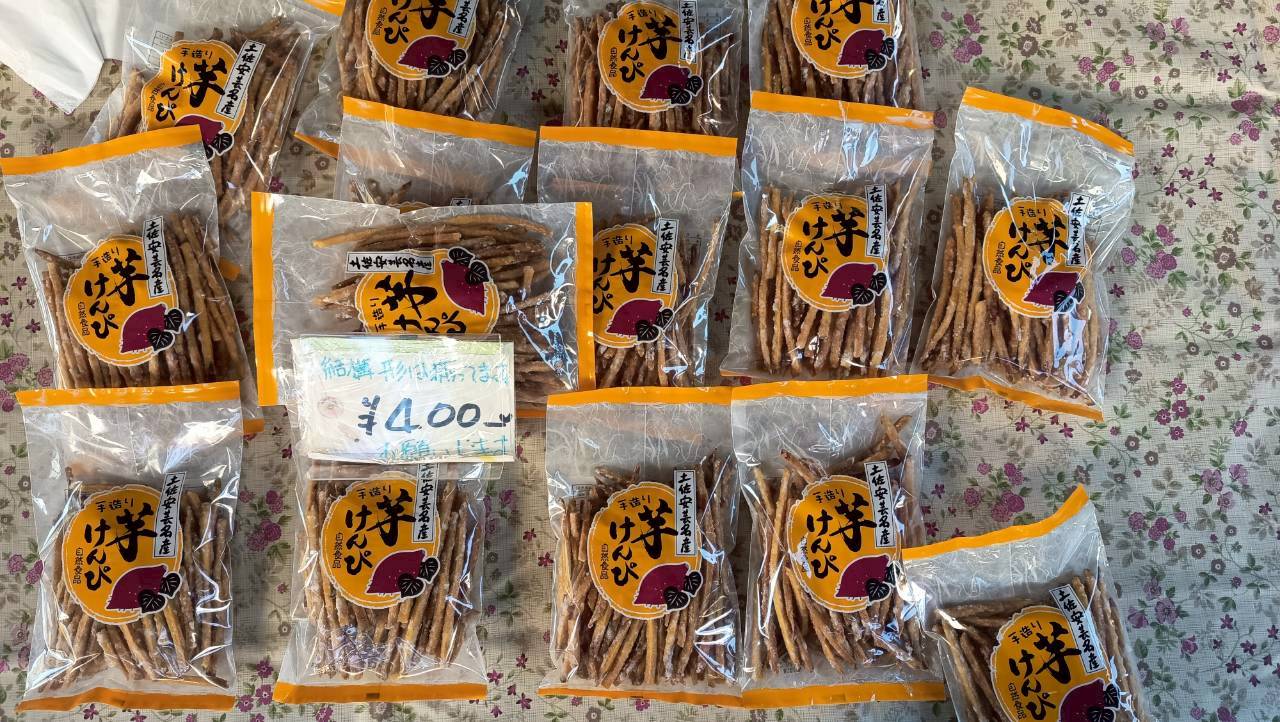
It is 9 a.m. on Sunday at Otesuji Sunday Market, the heart of Kochi’s weekend commerce. Ms. Yasue Nakayama steps behind her stall, opens a cardboard box of imokenpi from Terao confectionery shop in Aki City, and begins arranging the sticks in careful rows. The boxes are all the same size now, their plastic windows showing tight bundles of glossy, sugar-coated strips. She turns each one, so the sugar catches the light as she sets it down.
Years ago, she says, those bags on her table held irregular pieces at a cheaper price, the kind of snack families could scoop up on their way home. Now, the uniform boxes line up like bricks, each one a little more expensive than before.
“I used to sell a lot of the broken ones,” she recalls. “People were happy because they could get more, even if the shapes were strange.” She laughs softly, then looks down the street.
Around her, other vendors are opening their stalls as the sound of vendors calling out and the smell of fried foods and citrus begin to flow down the covered arcade. A few regulars stop to greet her, but most people walk past with tote bags that are still empty. The boxes of imokenpi wait on the table, untouched, as the morning gets brighter.

Imokenpi is a snack made from thinly cut sweet potato sticks, fried until crisp, and coated in a firm, glossy layer of sugar. In Kochi, it grew from a way to preserve sweet potatoes into a familiar treat that appeared on tables after school or with tea, long before it became a neatly boxed souvenir.
What is changing in front of her stall is not only the shape of the snack but the whole system around it. Imokenpi was once sold loose and inexpensive at local markets is now increasingly made in standard boxes for tourists and souvenir shops, often made by large companies that buy sweet potatoes from far away. The increasing costs of production, population decline, and the growth of souvenir-based tourism are pushing farmers, small vendors, and youth in Kochi to decide between adapting to this commercial model or to leave traditional work altogether.
For farmers who grow the potatoes, for confectionery makers who process them, and for vendors like Ms. Nakayama and her neighbours, this change decides whether they can continue to make a living out of sweet potatoes or whether they must leave the prefecture in search of stable jobs and, in effect, determines whether imokenpi will remain an integral part of the taste of Kochi or simply remain in souvenir shops.
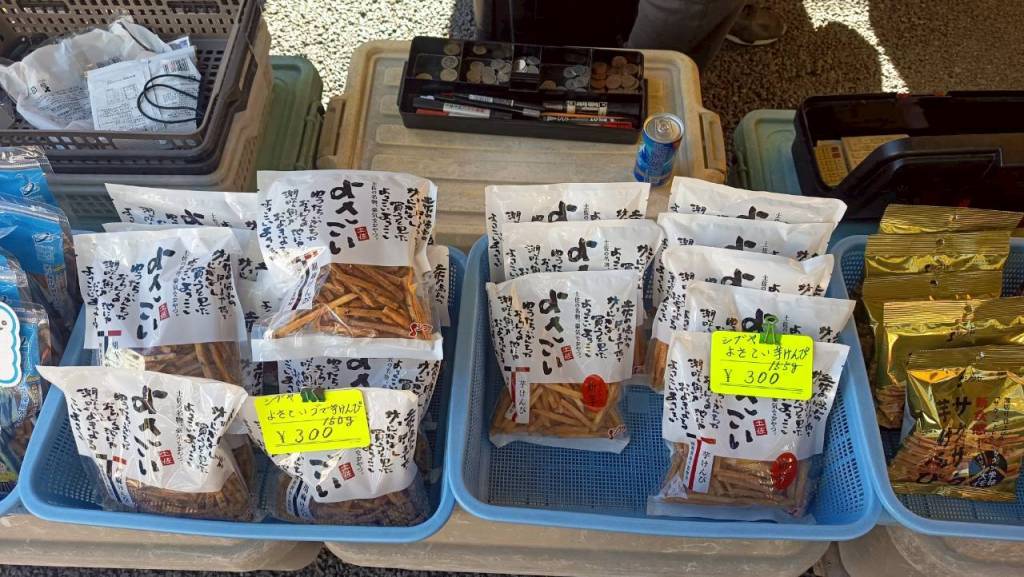
A few stalls down from Nakayama’s table, Mr. Takashi Matsumoto has spent more than twenty years selling sweet potato sticks in flavors that range from salt to sesame and black sugar.
“I was invited by a wholesaler at first,” he says, arranging bags of sesame imokenpi beside newer varieties. “Now people come looking for their favorite flavor, but they also compare the price with what they see in supermarkets.”
The potatoes he uses come from the Osumi Peninsula in southern Kyushu, a variety called Kogane Sengan that, he explains, “goes well with oil and makes a crisp, clean-tasting imokenpi.” Even here at the market, his products are tied into supply chains and branding decisions made far beyond Kochi City.
The quiet in front of some tables, particularly on slow mornings, implies that internet sales channels, convenience stores, and gift shops might be winning. The Sunday Market feels like a location struggling to maintain an identity that is subtly being drawn toward airport displays and tourist expectations as exhibitors wait for potential clients.
As domestic tourism expanded and regional branding became more important, imokenpi shifted as the packaging grew stronger and prettier, boxes became standard, and producers started to see it as a symbol of Kochi that could be sold anywhere in Japan. For companies and local governments, this shift made sense. Souvenir products bring in outside money and help promote the prefecture’s image, and imokenpi’s simple ingredients and crunchy texture made it easy to market to visitors.
But as more production and profit moved toward large-scale, standardized goods, the older version, which is the irregular, cheaper strips tied closely to everyday life began to retreat from local shelves, leaving vendors like Ms. Nakayama in a more fragile position.
Behind each box of imokenpi is a chain that starts in the soil. Farmers in Aki and other areas must deal with the rising costs for things like fertilizer, fuel, and labor. At the same time, they must sell sweet potatoes into a market where big buyers can pressure prices downward. For small producers, making imokenpi in tiny quantities for local sales requires small manufacturers to balance the expenses of electricity, oil, sugar, and packaging, then hope that enough people show up at markets to justify the effort.
At the larger end of the chain, a company like Imoya Kinjiro processes sweet potatoes at a scale that a single market stall can hardly imagine. The store manager say they now handle about 100 tons of sweet potatoes a day for several months at their main factory in Kagoshima, working with contract farmers across Kyushu to grow a variety called Kogane Sengan that suits frying and keeps a subtle sweetness.
“The three raw materials are sweet potato, oil, and sugar that decide the quality,” a company representative explains. “We have kept the same basic method since our founding.”
That consistency, along with investments in machinery and wholesale networks, helped the company overcome a 3-billion-yen debt crisis and expand into national and even overseas markets.yen debt crisis and expand into national and even overseas markets.
Standardization offers some stability such as larger orders, predictable packaging, and access to tourist channels, but it also concentrates power. When a snack becomes a branded souvenir, decisions about price, design, and distribution can shift from local shop owners to companies and wholesalers who may never set up a Sunday Market stall.
Farmers and small makers then face a choice, either adapt to this system and supply a uniform product for someone else to sell far away or try to keep producing the irregular cheaper versions that tie them to local customers but bring less profit and more risk.
On a Sunday in Kochi City, fewer people now rely on markets for their weekly snacks, because convenience stores and supermarkets are open every day and offer cheap, mass-produced sweets. For many residents, imokenpi has quietly moved from “something we buy regularly” to “something we might buy when visitors come” or “a gift we bring when we travel.” Airport shops and highway rest areas, with their bright lights and time-pressed customers, often sell more imokenpi in a day than a single market stall might sell in a week.
This change shapes how people think about the snack itself. Children who grow up seeing imokenpi mainly in gift shops may associate it more with travel and special occasions than with everyday life in Kochi. At the same time, tourists’ expectations for uniform taste, long shelf life, attractive design reinforce the trend toward standardized boxes and away from the messier, more personal versions made by small makers.
In many young people’s rooms, shelves are lined with brochures from urban companies promising stable pay, career paths, and clear training systems, while almost nothing advertises local farm work, markets, or sweet shops. Kochi had one of the worst occurrences of young outmigration in the nation occurred in between 2023 and 2024, with 4% of persons in their twenties leaving. This generation is felt in fields and at market stalls.
From the perspective of these young people, moving can seem like the most sensible financial decision rather than just a rejection of tradition. Remaining in Kochi might mean long hours helping parents in agriculture or at stalls like Ms. Nakayama’s, where even strong effort does not guarantee a secure income. As more youth decide to go, the traditions they might have inherited, growing sweet potatoes, learning recipes, negotiating with customers could lose potential successors, and imokenpi risks becoming one more symbol of a lifestyle that feels unsustainable rather than a realistic future.
The streets of Tosashimizu City already bear witness to that absent generation. By 9 p.m., a lot of stores are closed. The town is virtually silent that no one goes through the centre arcade, and the red illumination of a solitary convenience shop spreads out into empty walkways. Older locals recall a time when the lights from family-run businesses remained on late into the night and these same streets were packed with people and voices.
The same slow thinning is visible back in Kochi City at the Sunday Market. On the main street of Otesuji, Ms. Nakayama still lines up boxes of imokenpi in her stall each week. The goods are now procured by her daughter, who orders from Terao confectionery and carries the boxes for her mother, whose body no longer moves as it once did. If one day the daughter also struggles to keep lifting and ordering, there is no younger relative waiting in the wings. Amid the bustle of the market, a long-running stall feels more fragile each week.
Other vendors see the same pattern. Ms. Shiori Mizuta, a younger vendor who inherited her family’s sweet stall from her parents and grandparents, are the exception rather than the rule; in the neighbourhood where they live, the average age of stallholders continues to rise, and there aren’t many assistants under forty. Every young person who chooses to move to Osaka or Tokyo for employment loses not just a chance to become a farmer or shopkeeper, but also another opportunity for imokenpi to continue being a part of everyday life rather than merely a memory.
In recent years, imokenpi has established itself as a brand that travels far beyond Kochi. At companies like Imoya Kinjiro, sweet potatoes from contract farmers in Kyushu are processed into glossy sticks that appear in department stores and airport shops, and even in a shop in Seoul where, staff say, the products can sell out within hours. For customers picking up a box on the way home from a trip, the snack now belongs as much to the world as to the prefecture where it began.
One stall at a time, the Sunday Market on Otesuji Street closes. A vendor who used to pack up at three in the afternoon begins folding the table before noon, a store that once provided a variety of snacks now concentrates on a single product. One day, only the area where Nakayama’s stall once stood will be empty as the imokenpi boxes continue to pass through city stations and airports.
 Life in Kochi
Imokenpi is such an amazing snack representation of Kochi, I have tried them. The sweetness out of every single bite, really gives this nostalgic feeling. I’m not sure how to explain it, but it just did! By the way, I really loves how the story is told in this article. People need to come and visit Kochi ASAP!
LikeLike
Imokenpi is a very delicious snack which is one of the Kochi speciality. I really like the sweetness and the crunch at the same time. It makes me want to eat the Imokenpi more and more! Thank your for making this article about Imokenpi
LikeLike
Thank you for your nice article. I was not born in Kochi, so when I go back to my hometown, I always buy Imokenpi for my family. But I believe this traditional snack is a little expensive because it is gift for someone as Kochi. Hence, I was surprised to know that fact and I want to buy Imokenpi in the Sunday Market.
LikeLike
Loved this article. It’s amazing how something as simple as imokenpi can reflect such big changes in Kochi. Great Job!!
LikeLike
Imokenpi is one of the pride in Kochi. It’s difficult but I hope it continues to be loved by many people.
LikeLike
Amazing article! I love Imokenpi and I always think of it as a souvenir, but after reading this article I realize it was more than just a souvenir. Thank you for sharing this perspective!!
LikeLike
I didn’t know Imokenpi plays such an important role in Kochi. I learn many things about imokenpi. Thank you.
LikeLike
Great article.
I really like Imokenpi. I would like to a lot of people to eat many kinds of Imokenpi such as sold by Sunday’s market, Imoya Kinjiro and Mizugurumaya.
LikeLike
Imokenpi is a essential snack for people in Kochi. I’ve never had the ones sold at the sunday market, so I’d love to try them.
LikeLike
Such an inspiring article! it not just about simply buying or eating imokenpoi but a long story how imokenpi now become something more to Kochi. The way you explain the problem that happened now and how it is affecting local people is something we should be aware of. It’s helping me to know how a good thing for visitor actually gives a negative effect to local.
LikeLike