
By Kako and Anna
“Hurry up, hurry up!” a man who has arrived at the top of the hill yells at the people below in the video. “Tsunami is coming! Tsunami is coming! Run! Run!”
People panic, running for their lives.
The tsunami comes almost below his feet. The tsunami swallowed the people who were running in a second. A woman, almost reaching the men by an inch, was also swallowed away. This is a real story filmed by a man yelling during the Great East Japan Earthquake on 2011 March 11th. In this earthquake, 15,900 people died, and 2,523 were missing. 33 people out of 15,900 people were foreigners.
Kochi’s Worry: The Nankai Trough
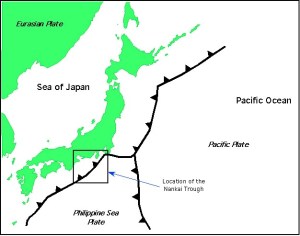
According to history, the oldest recorded Nankai Trough Earthquake was in 684. From that point on, the 13th Nankai Trough Earthquake happened. All the Nankai Trough earthquakes had a magnitude of 8.0 or more. The biggest earthquake was the “Hoei Earthquake,” which occurred in 1707 on October 28th in the Edo period. It is said that this earthquake was the biggest one in Japan until 2000. According to the Cabinet Office research, 5,045 people died in this earthquake. It is said that of this number, 1,844 were residents of Kochi. It is unclear, but 3 to 10 meters of tsunami washed in. In Kochi, it is recorded that 11 tsunamis waves occurred in the 18 hours after the earthquake.
Japan Meteorological Agency held a meeting about the Nankai Trough Earthquake this early June. They confirmed that the danger is even greater than previously predicted. In response, Kochi prefecture has been ramping up its preparations.
Help for Foreigners
Kochi prefecture has several ways to provide disaster support to foreigners. The Kochi International Association holds a “Disaster Prevention Study Group” for foreigners who live in Kochi. Kochi International Association is one of the organizations established to build relations between foreigners living in Japan and Japanese living in the community. In “Disaster Prevention Study Group,” foreigners and Japanese discuss disaster prevention and evacuation method. And they can try to make a simple toilet and food. In the activity, by learning in advance, it is expected that people will be able to evacuate in the happening of a disaster and they can respond quickly at the shelter. In addition, Kochi prefecture is preparing many ways to provide multilingual support in a disaster.
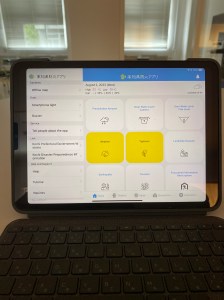
“We made pamphlets and applications in case of emergency.” Said Mr. Yamaguchi, who works in Kochi prefecture. There is information about the disaster, countermeasure method, and Hazard map by region. This pamphlet is written in Japanese, English but also in Chinese, Korean, Vietnamese, and Indonesian. The application can check the movement of heavy rain and typhoons, and there is a system that shows dangerous places and safe places on the disaster prevention map. These are ideas for foreigners who live in Kochi.
There are also measures for foreign tourists coming to Kochi. Some tourists who come to Kochi don’t know Kochi has the possibility that a big earthquake disaster will occur at any time. When tourists arrive, people working in tour companies and Kochi prefecture hand out a flyer explaining in detail the dangers of earthquake. It includes information about how to escape, where the shelter is, and what people should carry with them.
Kochi prefecture made a tourist information site for foreigners. This site is a valuable tool to get up-to-date information during emergencies. And when tourists are in their accommodation, their staff must correspond with foreign people. So, they are training how to respond to foreign tourists during an emergency.
The occurrence of a Nankai Trough earthquake cannot be prevented. Still, it is possible to minimize the damage as much as possible.
“We need to get information to every person in Kochi,” explained. Mr. Yamaguchi,
To this end, it is essential for prefectural governments, municipalities, and other administrative agencies not only to make maximum efforts to reduce damage but also to make the necessary preparations for prefectural residents based on the basics of disaster prevention, which is to protect one’s own life and protect one’s own area by oneself.
Under such circumstances, since many foreign tourists are expected to visit the prefecture in the future, it is necessary to prepare for the smooth and safe evacuation of foreign tourists visiting Japan at tourist facilities so that evacuation guidance can be provided in multiple languages in the event of a disaster.
Not a Miracle
One of the preparations Japanese citizens make for disaster prevention is drills in school. Most people in Japan start the training from preschool. From then on, they drill until high school. In kindergarten, elementary, middle, and special support schools, disaster prevention drills are held at least 11 times a year and at least four times a year in high school.
Have you ever heard of “Kamaishi Miracle”?
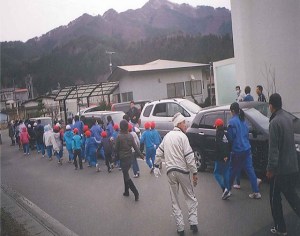
This is a story from the Great East Japan Earthquake. People call this a miracle because out of all the disasters from the Great East Japan Earthquake, not one of the students and staff members died in Unosumai Elementary School and Kamaishi Higashi Junior High School.
At first, it was said that a tsunami wouldn’t reach Kamaishi Higashi Junior High School. As a result, Unosumai Elementary students were evacuated to the 3rd floor of the school, where they were told to go. Looking at the middle school students running, the elementary school students started to run with them. They could do such a thing because of the joint training done with the Kamaishi Higashi Junior High School students daily. From there, they ran to the group home on a hill.
“It is said Kamaishi Miracle, but at first, we ran alone. I was worried about the elementary school students. Still, I didn’t dare to help them,” said Ms. Kikuchi, a middle school third grader. In an interview for Kurashi no Nakano Bonsai Nippon, she added, “People in the community helped us run and evacuate.”
They were on the cliff behind the building that had collapsed. From this, they decided to go a little farther group home. The famous picture was taken when they were going from the group home to the more distant group home.
There they say, the town was swollen by the tsunami. If they didn’t decide to evacuate, the tsunami also took them. To include this, people who saw the students running also ran with them. As a result, a lot of people evaluated. This leads to the number of people who were rescued.
“This is not a miracle! This is the result of measures,” said Mr. Yamaguchi with great zeal. “The disaster drills had worn on the students, but don’t forget about those who passed away that day. People must think more about those students and how they could have saved their lives with countermeasures.” These disaster prevention drills are done by schools where students run the training. This helps students beside what to do in any situation.
“It is important to take the initiative to evacuate,” saying it in a firm voice, he explains. When people see people around them evacuating, they will follow and start evacuating with them. This is already proven by the Kamaishi miracle, where residents evacuated together with the students who were running.
Food Stockpiles
One another important thing is to have a stockpile of food that will be able to get and run with. It can be anything that can be stored.
“Do you know the method called rolling stock?” Mr.Yamaguchi asked. “This is where your food and drinks that you usually buy at the supermarket, for example, instant noodles or instant rice and so on. You put this in your evacuation bag. Then, if the spending deadline gets close, you will eat it as your dish and return to repurchase it. It goes on and on and on.” Explaining how this method works.

This food stock is crucial, but according to the survey done by Kochi Prefecture, the personal stockpile is only 32.6% of water and 38.0% of food for three days.
“This is not enough.” Says Mr. Yamaguchi, “The personal stockpile is under 50%. The issue here is there’s no space in the house where we can put those items. Also, people don’t understand the importance of the personal stockpile.”
The prefecture’s stockpiles are assumed for 260 thousand to 310 thousand people. Now they have reserves of food and water, about 80%, but the blanket they need is only 50%. After the stock finishes, they team up with the local supermarkets and use their food stockings there so everyone can eat.
“It is said in Japan that after a disaster, we will need food and water for three days before the rescue or the supply from another prefecture comes to help the people. Still, it is important for us to pack our bags of food and water for a week, just in case,” says Mr. Yamaguchi in a severe voice.
The danger of the Nankai Trough earthquake has been said for a long time. The predicted tsunami arrival point was 9.3 meters or more in the Great East Japan Earthquake. However, the biggest tsunami was 28.8 meters. From this, people can see that they did not prepare for the biggest disaster that might have happened. After the Great East Japan Earthquake, the entire country looked over the Nankai Trough earthquake’s tsunami, predicted arrival point, and how strong it would shake if it happened. The first prediction for the tsunami was 10 meters, but now it is expected to be 35 meters. It is said that it will arrive in 3 minutes at the fastest. It was said it would be in the upper five on the Japanese earthquake scale, but now it is set as an upper six.
“We can’t set the scale as seven because there is no end to it!” says Mr. Yamaguchi. “It can be close to the upper 6, or it can be way bigger. We won’t be able to predict how big it will be.” explaining how upper 6 is the best prediction and preparation they can do before the Nankai Trough earthquake happens.
The Hoei Earthquake in the Edo period happened 50 days after that, Mt. Fuji erupted, called the “Hoei Eruption of Mt. Fuji.” It is said that this eruption occurred because of the Hoei Earthquake moving the tectonic plates. Mt. Fuji’s eruption happens in 10 years to 900 years.
This might sound discomfiting, but it has been about 300 years since the last eruption. There is also literature about Mt. Fuji erupting after a big earthquake happens, and it is not only once or twice, but more. Therefore, there is a rumor about Mt. Fuji erupting when the next Nankai Trough earthquake happens. This is just a rumor, but we can’t ignore it because there is a case where Mt. Fuji erupted after the Nankai Trough earthquake.
We all should be aware of the secondary damage and so on. This is shown enough by where the entire country reviewed the plan about the Nankai Trough earthquake. Now it’s our turn to think and learn about the Nankai Trough earthquake and prepare for things that we need.
“Be aware and prepare for the most calamitous situation,” said Mr. Yamaguchi in a strong, stern voice. “It just might save your family’s life,”
 Life in Kochi
As a foreign resident who residing in Kochi, I’m really thankful to the authors who dedicated themselves to writing this article in English, I personally have difficulties understanding and speaking in Japanese, which means I got no access to this vital information.
LikeLiked by 1 person