

By Murono, R.
“Down with the revision of the Immigration Control and Refugee Recognition Act!” the protestors chant. “Give parolees residency status!”
Passersby on the busy streets of Obiyamachi, the most crowded shopping district in Kochi, pause to read the large banner. .
“If you don’t know what this means because there are no foreigners around,” says a protestor, “please take a flyer and read it.”
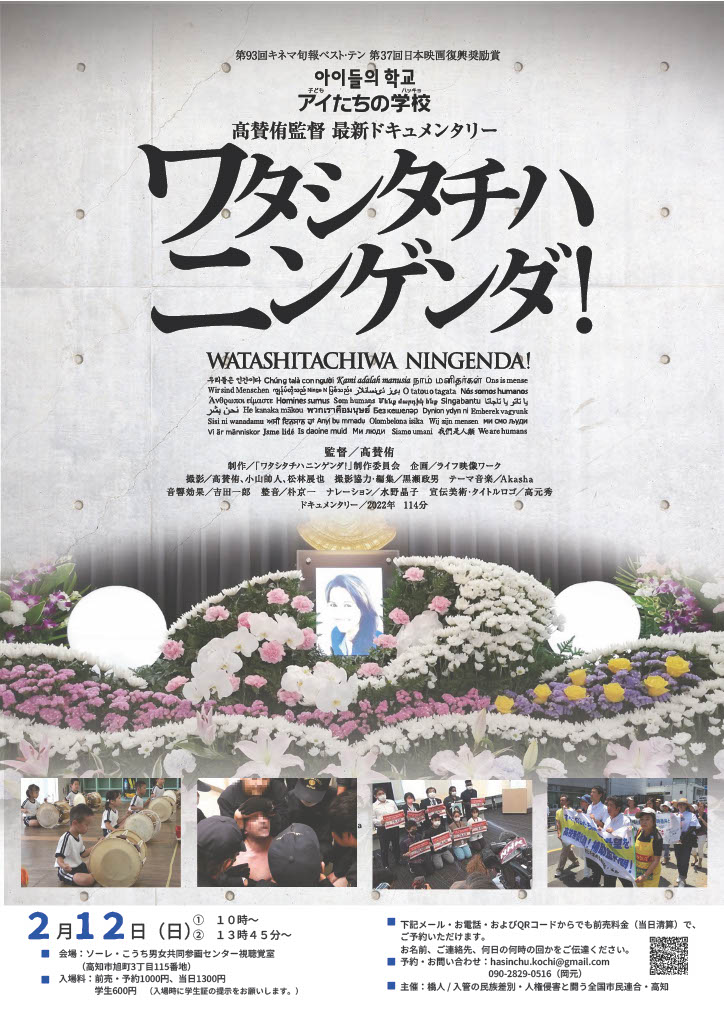
The voices of Hasinchu, a group formed by Kochi University students, echo through the streets. Young and old, they hold placards and distribute flyers. Some pedestrians take the flyers, while others bow and continue on their way.
Hasinchu was formed in 2016 by students from Okinawa who believed that the U.S. military base issue was not just an Okinawan problem. In 2020, they were asked by the Japanese Student Network to discuss immigration issues. Hasinchu protests the government’s treatment of foreigners in Japan, arguing that discrimination against foreigners is a root cause of conflict and ties into their earlier activism.
Since April, Hasinchu has held biweekly demonstrations, involving local residents.
“The immigration bill has been passed,” said a Hasinchu member after a one-hour demonstration. “But let’s continue our protests and push the Minister of Justice to allow minor provisional releasees to stay in Japan.”
According to Hasinchu, the proposed changes to the Immigration Control and Refugee Recognition Act would allow the deportation of individuals who apply for refugee status more than three times, even during the application process. It would also punish those who fail to follow deportation orders. Despite significant concerns, the bill was pushed through the current Diet session.
The group criticizes the government for not fully disclosing important legislative facts, such as changes in the number of repatriation evaders and issues related to repatriation quotas. They argue that this lack of transparency and the forceful adoption of the bill will make the situation even more difficult for those affected by immigration policies.
Hasinchu believes that, even if the bill doesn’t pass, there are numerous problems with Japan’s immigration system: violence in detention camps, a dysfunctional medical system, and a lack of human rights during provisional release. One of the biggest issues, they say, is the general public’s lack of awareness.
“To solve these problems, we need to raise awareness,” said Hasinchu members, who have been actively organizing film screenings, distributing flyers, collecting petitions, and holding street demonstrations. “We even took charge of a class at Kochi University to speak directly to students. This is a societal issue, and public opinion is crucial to move the government. Voices from across the country, including Kochi, where there are no foreign internment camps, are essential to make the government aware of the various harmful effects.”
Although the Immigration Control and Refugee Recognition Act amendment bill passed in the current Diet session, the government had previously submitted a similar bill in 2021, which was scrapped due to strong public opposition. This highlights the significant influence of public opinion.
“There was strong public opposition this time as well,” said all Hasinchu members.
Demonstrations occurred nationwide, with thousands gathering in front of the National Diet and in areas like Shibuya and Ginza. Over 144 standing protests were held across Japan, including solo protests. Hasinchu’s demonstration was part of this movement, contributing to the formation of nationwide public opinion. Hasinchu believes the government was pressured into passing the bill quickly, fearing it might not have another chance if it delayed.
Being active in Kochi has encouraged like-minded individuals and groups nationwide.
“We get comments from people thanking us in Kochi and from lawyers saying, ‘Our colleagues in Kochi are doing their best,’” said Shoichiro Yamada, a sophomore at Kochi University who runs Hasinchu’s Twitter account focused on immigration issues.
Minaki Arakawa, a third-year student at Kochi University, emphasizes the importance of keeping the affected individuals in mind during their activities, even from a distance.
“Hasinchu uses long vacations to attend court hearings and meet with detainees. Usually, it’s not easy to engage in these activities from Kochi, but witnessing the tense situations and the injustices faced by the people involved has strengthened my resolve to protest.”
Arakawa attended the trial of Wishma Sandamali, a 33-year-old Sri Lankan woman who died in an immigration facility in Nagoya, Japan. Her bereaved family demanded the disclosure of 295 hours of video footage from her detention. Arakawa was struck by the government’s lack of remorse in response to the family’s grief-stricken plea for accountability.

At a supporters’ meeting after the trial, Arakawa expressed her thoughts as a representative from Kochi in front of the bereaved family, feeling the weight of her words.
Arakawa, a student in the College of Agriculture, Forestry, and Marine Sciences, admits she hadn’t heard of immigration issues until a friend invited her to join Hasinchu. She believes that emotion is a fundamental aspect of support activities, driven by a sense of injustice.
Mr. Yamada, a science and engineering student, has been involved with Hasinchu since attending one of their film screenings. Despite his interest in global issues, he struggles to understand how something so unreasonable and cruel as Japan’s immigration policies can persist.
“The immigration issue is about human rights,” Yamada said. “It could eventually lead to conflict. Human beings are human beings, and violating human rights is wrong, regardless of the circumstances.”
Arakawa added, “The number of foreigners in Japan is increasing, but the system treats them as if they don’t exist. Foreigners who are beneficial to Japan are accepted, while others are only allowed to stay temporarily, with the expectation that they’ll return home. If we don’t address this issue, discrimination will worsen, and more Japanese people will start to view foreigners as a threat to their jobs, deepening the division in our society.”
Arakawa is focused on creating a better future.
“Hasinchu is written with Chinese characters that mean ‘bridge’ and ‘human,’” she said. “It symbolizes a bridge between Okinawa and mainland Japan, between young and old, and between the past, present, and future.”

Twitter: @hasinchu_sien
Instagram: @hasinchu.kochi
Gmail: hasinchu.kochi@gmail.com
 Life in Kochi
Working for someone is easy to say, but actually acting is difficult. This group is really great. Protect the vulnerable, please.
LikeLiked by 1 person
I am happy because I can know the team of hashinchu.I think there are various of opinon about this problem. So it is need fo us to learn the fact of this problem and when we may realize we have to make some action, we need to stert to do to make bright future.
LikeLiked by 1 person
Thank you for Hasinchu’s hard work! Considering how Japan become a popular destination for tourists, looking for a day when foreign and local people can live together without discrimination.
LikeLiked by 1 person